 WMO
WMO
WORLD BANK: State and Trends of Carbon Pricing 2026, INTRODUCTION & TOWARDS GOVERNMENTS
1.1 Carbon pricing is an important part of governments’ policy toolbox
Governments are currently facing unprecedented disruptions to global commodity supplies. Policy makers are navigating the impacts of commodity price increases and supply disruptions on their populations. This includes the potential to adjust carbon pricing policies such as Emissions Trading Systems (ETSs) or carbon taxes. In other instances, governments have already taken actions, such as the government of Ireland’s announcement on April 12 to delay an increase in its national carbon tax from May to October 2026 due to rising fuel costs.
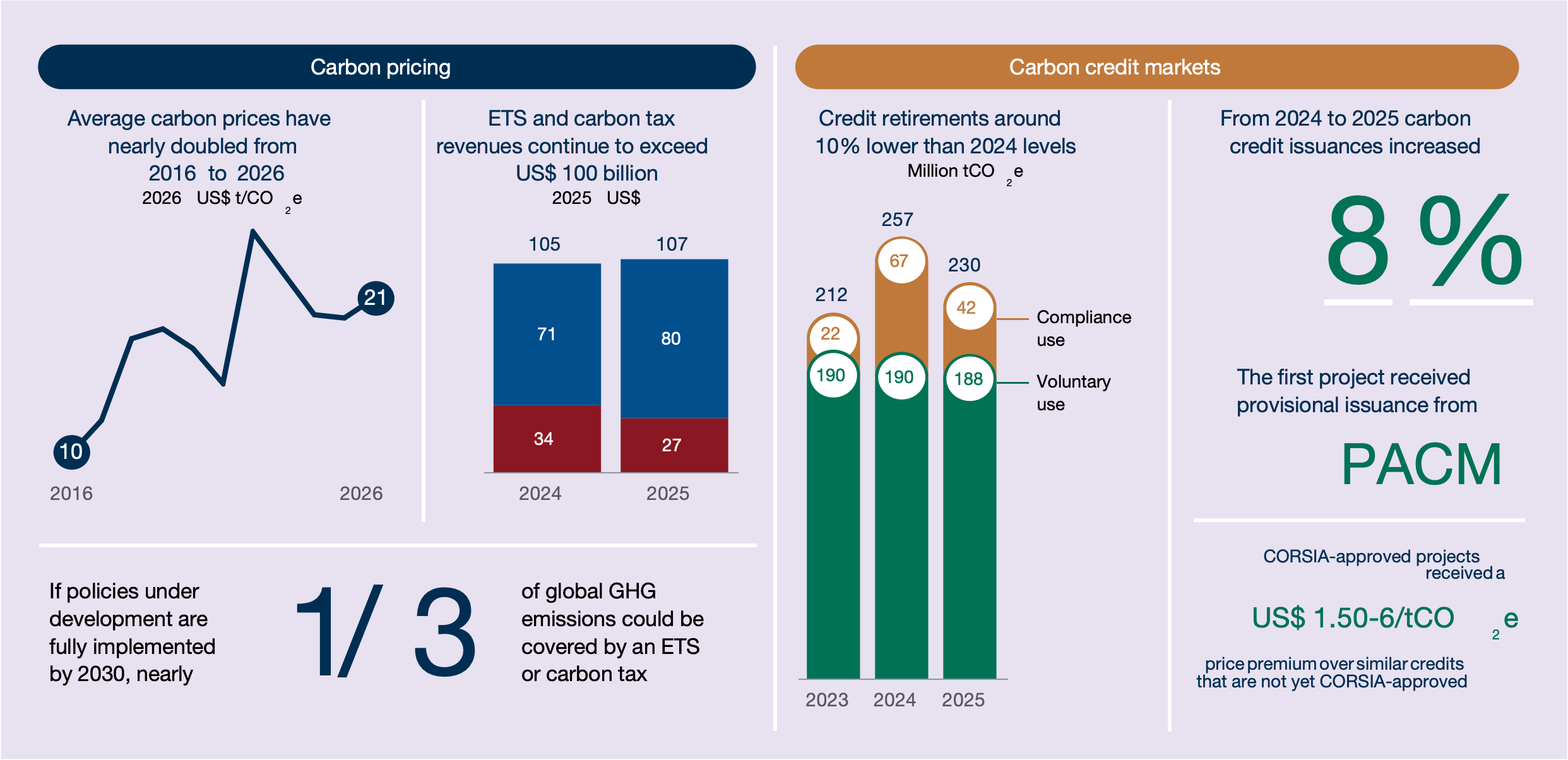
When viewed over a longer time frame, many governments are choosing to implement carbon pricing as a tool toward achieving development and economic objectives. Direct carbon pricing through a carbon tax or emissions trading system can contribute toward achieving countries’ own emission reduction targets, including Nationally Determined Contributions (NDCs). ETS with a declining absolute emissions cap or intensity baseline can incentivize covered facilities to reduce their emissions over time and can offer important long-term benefits beyond climate mitigation, including facilitating investment flows, promoting affordable, domestically-sourced energy, increasing energy security and providing a new source of government revenue.
Between 2016 and the start of 2026, carbon pricing has expanded and diversified.
Paris Agreement did not feature its own operational market mechanisms. Instead, international carbon markets focused on units created by the flexibility mechanisms under the Kyoto Protocol, including those certified under the Clean Development Mechanism and Joint Implementation mechanisms, though demand for these credits had already peaked several years earlier. By contrast, credits from independent crediting mechanisms represented a smaller share of total issuance, and were mostly used by companies as part of voluntary climate commitments.
Carbon credit markets are a mechanism to mobilize both public and private finance, particularly in developing countries. Carbon credits direct private capital toward projects that reduce or remove emissions and can help achieve broader development objectives such as improving health outcomes or environmental protection. The size of the carbon credit market has increased significantly since 2016, driven by voluntary demand for carbon credits. The traded value of carbon credits was estimated to be over US$ 500 million in 2024, below the highest observed level of US$ 2.1 billion in 2021 but more than double the 2016 value. Recent buyers’ interest in credits has been for projects focused on nature-based activities such as conservation and reforestation. For example, between 2021 and 2024, 70 percent of all capital committed or directly raised for carbon credits were for nature-based activities. This is particularly the case for nature-based removal (carbon removal or sequestration) projects, such as afforestation and reforestation, that have been increasingly favored by buyers and command higher prices than most other types of carbon credit project.
Tropical Forests Forever Facility (TFFF), proposed by the government of Brazil, is designed as a non-carbon, results-based financing mechanism that provides long-term payments to tropical forest countries for the conservation of standing forests, measured in hectares rather than in emissions reductions. TFFF does not generate emission reductions or carbon credits, and is not an alternative to REDD+ (Reducing Emissions from Deforestation and forest Degradation plus conservation), which remains a climate-mitigation mechanism that rewards verified emission reductions and removals from deforestation and forest degradation. Instead, TFFF is intended to complement jurisdictional REDD+ by providing a sustained source of finance for forest conservation, particularly in contexts where deforestation is already low or declining and there is no carbon crediting potential, thereby strengthening the overall forest finance architecture.
1.2 Scope of this report
A.Emissions trading systems, where a jurisdiction places a limit, or cap, on the amount or intensity of GHG emissions generated by regulated (covered) entities.
B.Carbon taxes, where a government levies a fee on covered entities for their GHG emissions.
C.Carbon crediting mechanisms, where tradable credits are generated through activities that reduce emissions through either avoidance or reduction or removal. Carbon crediting is increasingly linked to carbon pricing, where specific types of carbon credits may be used to help businesses comply with an ETS or carbon tax. This report covers domestic and international, as well as compliance and voluntary, carbon credit market activities.
Despite recent growth in both carbon credit markets and carbon pricing, indirect carbon pricing remains the dominant mechanism. In contrast to direct carbon pricing, indirect carbon pricing (such as fuel excise taxes, or conversely negative carbon prices applied through fossil fuel subsidies) changes the price of products associated with GHG emissions but is not explicitly linked to GHG emissions. Indirect carbon pricing policies operate at a larger financial scale than direct carbon pricing. The estimated traded value of carbon credits in voluntary carbon markets was approximately US$ 535 million in 2024. Global investment in carbon credit projects, notably via forward-looking off-take agreements, could offer a signal for future market direction.
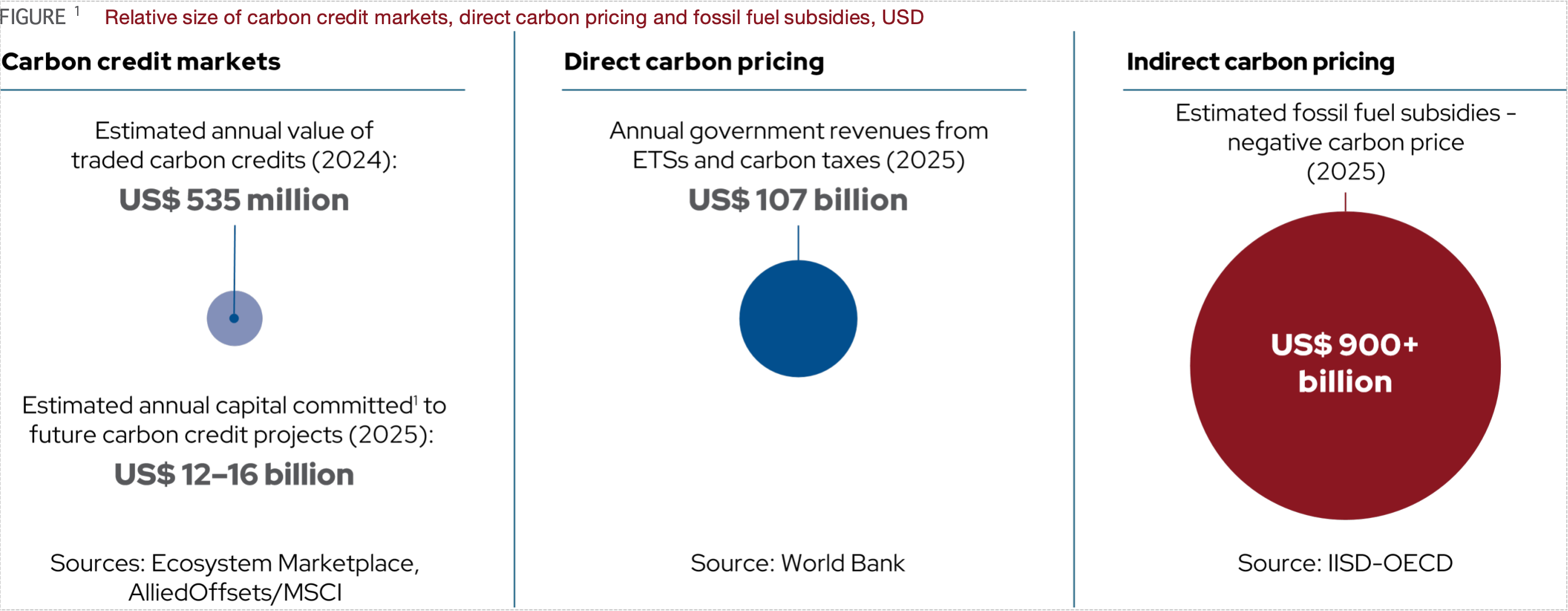
For 2025, capital committed is estimated at US$ 12-16 billion (though not all relevant projects will be fully implemented). To put this in perspective, government revenues generated by ETSs and carbon taxes are consistently mobilizing over US$ 100 billion for public budgets. However, estimated subsidies for fossil fuels globally accounted for more than US$ 900 billion in 2024 (this precedes the recent disruptions in global energy markets). Despite the difference in scale, understanding developments in direct carbon pricing is critical for policy makers who are implementing or reforming their own ETS or carbon tax.