 WMO
WMO
Carbon Standard: A Proposal for a New Global Monetary Order Based on Climate Currency
A new international monetary system based on climate currency (the carbon standard) to tackle two pressing externalities in today's global economic and political context: the dangerous and irreversible effects caused by unconstrained green-house gas emissions and the cost to the rest of the world as a result of the U.S. dollar being the dominated global currency and the U.S. Federal Reserve increasingly implementing monetary policies not aligned with the global common interest.
Climate currency as standardized carbon-related securities backed up by the right of one unit of carbon emissions to be used as a new global reserve currency and functions as an international unit of account. Through the trading of climate currency, efficient carbon prices are established. By incorporating the cost of carbon emissions into decision making, carbon pricing provides incentives for countries to pursue low-carbon growth, which helps achieve the net zero emissions global goal set under the 2015 Paris Agreement.
1、Introduction
There are two interlinked externalities which are challenging the sustainable growth of the global economy and undermining the foundations of world order: (a) the dangerous and irreversible effects due to climate change caused by unconstrained greenhouse gases (GHGs) emissions; and, (b) cost to the rest of the world with the U.S. dollar being the sole global currency.
Without incentive compatible mechanisms well in place, an irresponsible economy would have every motive to stick to heavy-carbon technologies to grow its own economy, with the rest of the world bearing the hazards resulting from its unconstrained carbon emissions. Hence, carbon emission is a classical case example of negative externalities.
To align with the global common interest, climate currency in which exchange rates of national currencies are pegged to carbon prices and can be labeled as the CARBON STANDARD which is about the conflicts of economic interest between domestic monetary independence and external stabilization for countries that are exposed to the U.S. dollars.
The U.S. dollar dominated international monetary system poses another type of externalities. As the supply of dollar is exclusively controlled by the U.S. Federal Reserve, which implements monetary policies with sole objectives of maximizing the U.S. economic welfare without considering potential externalities to the rest of the world. The 2008 Financial Crisis and the on-going COVID-19 Pandemic have demonstrated how the U.S. exploited the dominant role of U.S. dollar for the purpose of its own. The U.S. has printed a sizable amount of dollar, through multiple rounds of quantitative easing, effectively spreading the crisis to the rest of the world, since the world always has a demand of dollar as safe assets during crisis.
The global economic systems have been designed and optimized for a certain level of risk. Such systems become vulnerable and call for changes when the level of risk reaches to systemic thresholds. In fact, the two externalities are pushing risks associated with the current international monetary system to thresholds, so that a new system is in an urgent need. Rather than the U.S. dollar, climate currency as standardized carbon-backed securities backed up by the right of one unit of carbon emissions. Under this system, the carbon prices denominated in Euro, U.S. dollar and RMB and other currencies are established through trading on the emission trading systems (ETS).
Efficient carbon prices provide financial incentives for market participants to reduce carbon emissions or increase carbon capture, utilization, and storage (CCUS). One prominent feature of this system is that the exchange rates of national currencies are pegged to carbon prices with some similarities between this new system and the gold standard.
Under the carbon standard, the external shocks to international monetary system would come from variations of carbon emission, instead of the U.S. monetary policies. Then monetary authorities’ commitment to maintain stable exchange rates will be consistent with monetary policies aiming at pursuing low-carbon growth. Therefore, the carbon standard may provide a plausible solution to the classical Mundellian Trilemma.
Introducing climate currency into international monetary system can yield one prominent feature: exchange rates of national currencies are pegged to carbon prices. Carbon-based international system runs many similarities to the gold standard under which each country pegged its currency to gold and gold served as the sole reserve currency.
2、Money has three fundamental functionalities: unit of account, median of exchange and store of value:
2.1、Climate currency as a unit of account: addressing the two externalities. Efficient carbon prices make emitting carbon more expensive and attracts investment into projects reducing or removing emissions, both of which would endow market participants with climate currency. With net-zero commitments continuing to proliferate, it can help jurisdictions and corporations to internalize the cost of GHG emissions and enable a shift to a low-carbon economy by including carbon pricing as part of the strategies. All of these have provided promising fundamentals for climate currency to serve as an international reserve currency, particularly as an international unit of account.
2.2、Climate currency as a medium of exchange and a store of value. Exchange rates are pegged to carbon prices denominated in national currencies under the proposed carbon standard where declining carbon prices would be translated into appreciation of the value of their national currencies. Climate currency can function as an international unit of account, given the existence of various fiat monies already serving as media of exchange in the world. New Monetarism literature provides good micro-foundations for money to serve as a medium of exchange and as a store of value in an overlapping-generation model.
2.3、Under the U.S. dollar dominated international monetary system, non-US countries lose the independence of their monetary policies, as they are forced to implement policies to counter the “Global Financial Cycle” driven by US monetary policies.
2.4、Central banks should be particularly interested in having carbon backed securities as part of their reserve portfolio because it would give them policy options on their economies’ carbon emission.
2.5、Under the carbon standard, the external shocks to the international financial system would come from variations of carbon emissions rather than the U.S. monetary policies, monetary authorities’ commitment to maintain stable exchange rates come together with monetary policies aiming at pursuing low-carbon growth. The new system potentially poses a plausible solution to the classical Mundellian Trilemma because the objectives of maintaining fixed exchange rate and implementing monetary policy become one.
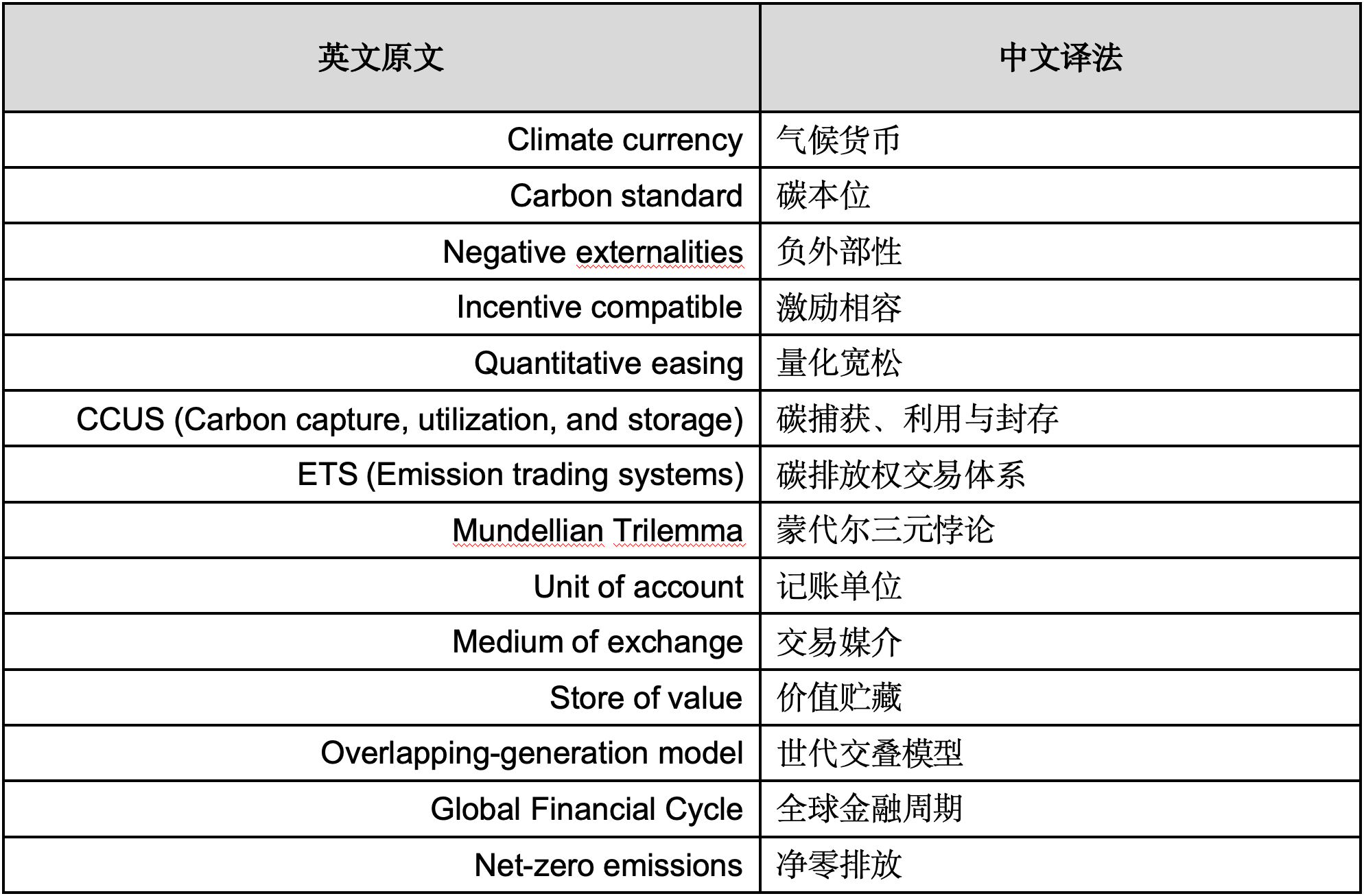
Comparison Table of Technical Terms